Time to gear up and get back to exploration
WILLIAM (BILL) HEAD, CONTRIBUTING EDITOR
What Article Three, U.S. Constitution, actually allows. “The Biden-era Alaska oil and gas leasing program [ed., that is a Presidential Executive Order plus invented EPA standards] violated the law and improperly limited Alaska’s energy potential with unreasonable regulation,” said Acting U.S. Attorney General Todd Blanche. “This settlement supports the Trump administration’s commitment to secure American energy independence and our national security for generations to come.”
“This settlement sets the record straight that the Biden administration’s 2024 restrictions on oil and gas production in Alaska were overly restrictive and contrary to Congress’s clear command to establish a competitive oil and gas leasing program in Alaska’s Coastal Plain…Trump’s commitment to unleash Alaska’s extraordinary resource potential …The settlement concedes that the 2024 Program violated the 2017 Tax Cuts and Jobs Act in various ways, including by:
- effectively abdicating Interior’s duty to conduct a second lease sale;
- closing 75% of the 1.56-million-acre coastal plain to exploration and leasing;
- imposing unreasonable surface use restrictions on the remaining 25%; and
- unreasonably restricting surface disturbance to 995 acres Program-wide, instead of the “up to 2,000 acres” explicitly provided for in the Tax Act.
…“The Bureau of Land Management will now administer its oil and gas leasing program according to the plain meaning of the controlling statute. That means more oil leasing, more domestic energy, and more independence from foreign sources of energy.”
Places I know firsthand that could use another exploratory look, just to name a few:
United States Gulf of America/Mexico, Texas, Canada, Mexico, Guatemala, Vietnam, Indonesia, Brazil, Venezuela, Colombia, Argentina, Peru, Chile, Bolivia, Norway & UK North Sea, Dutch North Sea, Egypt, Syria, Oman, Abu Dhabi, Dubai, Qatar, Angola, Namibia, South Africa offshore, Madagascar, Nigeria, Ivory Coast, Gabon, Algeria, Tunisia, Libya, Israel, Russia-Sakhalin, Malaysia, Western Australia, New Zealand, Papua New Guinea, and Trinidad.
A Google AI search for the best places to look for oil tells me I should have added the Permian basin, but I have only brief research experience there. Evidently, AI has not caught up on the latest data, say over the past 100 years!
Google AI did get it right, in my opinion: 3D and 4D seismic are the best technologies to use to find oil. Admittedly, the search did say it does not understand the approach for mapping underground ‘rock structures,' but it did recommend its sister AI supercomputers for data analysis. GravMag was listed, as was EM. AI got it wrong that EM was a preferred tool to GravMag. AI could do better at segregating the publications of the AGU from those of the SEG, the AAPG, or the SPE.
I think Google AI was completely wrong to state that AI supercomputing analysis was performed by the machine, as if there were a certain button that pushed itself. Not yet, among the actual oil finders and reservoir completers.
The myth of FWI and the AI savior. Mini-managers, in the quest for push-button solutions without paying for a team of experienced explorationists backed by competent reservoir engineers, shout that AI will solve the payroll dilemma by providing complete descriptions of the geosurface within minutes of pushing the button. That practice has failed every other technological advance. Yes, massive AI should reduce the enormous computational time required to incorporate FWI into your toolkit. But have you noticed the hysteria in America over data centers? Never mind, data centers are required for your cell phone, car, and internet.
Further, Full Waveform Inversion is just an expensive earth model as input with theoretical acoustics or elastic simulation created to compare with recorded data. See any attention from ANY professional paper on the actual recording tools, practices, and limitations? No. Hardly mentioned at SEG/AAPG or SPE. FWI relies heavily on extremely low-frequency field data and massive computational resources. Additionally, the industry over the past 50 years has been on a crusade for the grail of high-frequency resolution accuracy placed within x, y, z space. However, FWI modelers require a very low recorded frequency to make predictions. While VLF can be resampled from M-HF or VHF data, simulated digital truth will reveal little about elasticity, compared to real, field-recorded shear wave data. Oh, what to do? Mini-manager falls on the AI sword once again.
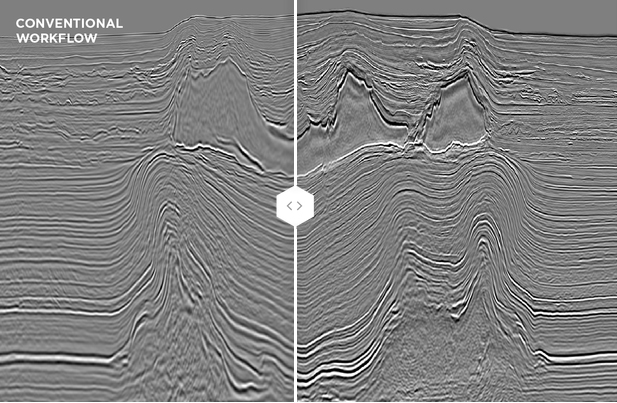
A possible solution is to look to tech in evolution, not in China, but with an Aussie group that has gone global. They even have a former SEG President on their board who, in person, has demonstrated superior knowledge of geophysics. DUG has been around for a while as a successful innovator, while others have just been copying trends. One example was the data center that was installed years ago in West Houston, which operated an enormous computer bank that was liquid-cooled, not with water. That insight put them in front of computational AI early. I offer an example of “simple” seismic data processing that allows freedom to iterate until an improved [but not perfect] image has been obtained that experienced geoscientists would want to interpret, Fig. 1.
I challenge you to access the DUG website and play with the interactive handle on the graphic. Yes, other processors and interpretation software can exhibit this behavior. But how many will direct the geo interpreter to improve areas of interest, then offer rather immediate recomputation?
Rocks do matter. A professional read with a large cup of decaf:
James McLeman, Jennifer Badry, Tom Rayment, and Alex Pauli, “Unlocking rock properties using viscoelastic multiparameter FWI,” The Leading Edge, May 2026. https://doi.org/10.1190/tle-2025-1055
Reality is often only millions of dollars away within one wellbore, drilled properly, logged with a real sonic tool, but not completed by good ole boy thinking, and then tested by state-of-the-practice steady-state thinking.
Related Articles- Unlocking the untapped potential of legacy seismic data using modern processing and imaging technology (June)
- Building a smarter model for sustainable land seismic operations (May)
- What's new in exploration: Financial distractions, investor rationalizations, exploration laments (May)
- Opening new frontiers in formation evaluation: Transforming subsurface insight with intelligent imaging-while-drilling (April)
- What's new in exploration: I bet you wish you had kept your Exploration priority today! (March)
- International E&P shows the way forward (February)