Executive Viewpoint: Why produced water filtration needs a rethink
OSCAR VELASTEGUI, VEOLIA

The oil and gas industry faces a persistent challenge: managing the massive volumes of produced water generated during extraction operations. This water, contaminated with oil, gas, solids and other harmful substances, cannot be discharged untreated without causing environmental harm. For decades, nutshell filters have been the industry standard for treating this water, but traditional designs have been plagued by high costs, maintenance headaches and operational inefficiencies.
Today, a new approach to nutshell filtration design is challenging those assumptions, rethinking how produced water treatment can be made more efficient, durable and practical in modern oil and gas operations.
Since the 1970s, nutshell filters have been the go-to solution for produced water treatment in oil and gas operations. These filters use crushed walnut shells, typically sized between 0.5 mm to 2.0 mm, as filtration media. The shells' irregular shapes with sharp edges effectively trap oil and solids, while their low density and durability make them superior to alternatives like sand or anthracite.
WHY TRADITIONAL DESIGNS FALL SHORT
Most existing designs share common flaws that make them both capital-intensive and operationally demanding. Traditional systems require a dedicated pump or agitator mounted on top of each filter vessel, along with internal or external strainers (called scrub screens) to allow wash water to pass while retaining the media. This configuration creates multiple problems.
First, it’s maintenance intensive. Equipment mounted on top of vessels requires large platforms and ladders, making routine inspection and maintenance difficult, time-consuming and potentially dangerous. Next, each filter needs its own pump and associated hardware, equipment that's only used briefly during cleaning cycles, representing an inefficient use of capital that multiplies across multiple filter installations. Many designs use flat screens that can only withstand a fraction of the vessel's design pressure. These screens require extensive supporting structures prone to corrosion, and when they fail, the result is substantial downtime and expensive repairs. Finally, internal and external scrub screens can become clogged with media fines and crude oil, extending maintenance requirements and filter downtime.
RETHINKING FILTRATION SYSTEM ARCHITECTURE
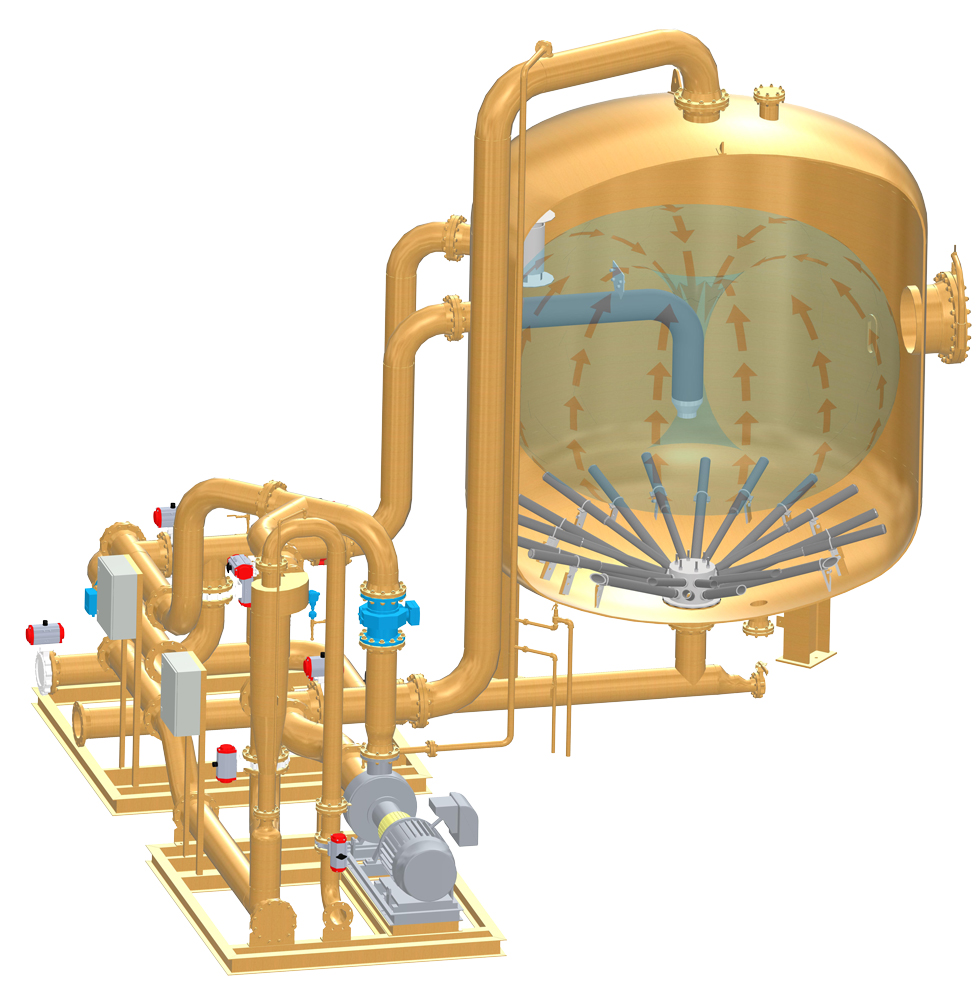
One recent development, Veolia’s patent-pending ToroJet system (Fig. 1), seeks to address several longstanding limitations of conventional nutshell filtration designs by simplifying cleaning, reducing equipment complexity and improving media recovery. By centralizing cleaning functions, eliminating vessel-mounted moving parts and using cyclonic separation to preserve healthy media, the design lowers capital and maintenance demands while improving reliability and uptime.
As a result, the model goes beyond technical specifications, delivering tangible benefits across multiple areas. It reduces both upfront and ongoing costs by simplifying equipment needs and sharing key cleaning functions across multiple filters. Lower media loss, fewer shutdowns and easier maintenance help improve operational efficiency and productivity over time. Safety is also improved through ground‑level access that reduces risk during inspection and servicing. A modular, compact footprint allows capacity to scale incrementally without major site modifications or added mechanical complexity.
Beyond operational efficiency, the technology supports critical environmental and sustainability goals. The ability to effectively treat and recycle produced water offers significant advantages, including conserving freshwater resources, a crucial consideration as water scarcity becomes an increasingly pressing global issue.
Currently, the overwhelming majority of produced water is disposed of through well reinjection. However, with effective treatment systems, this water can potentially be recycled for subsequent operations, reducing the industry's freshwater footprint and supporting sustainability initiatives.
From Gene Hirs's original dual-bed system in 1974 through various iterations by inventors like Clifford Hensley, Jack Bratten and Irving Dean, every generation has sought to address the limitations of previous designs.
What distinguishes these newer designs is a fundamental rethinking of the filtration system architecture. Rather than incrementally improving existing designs, it eliminates problematic components and relocates critical equipment to ground level, where it can be shared across multiple vessels.
INNOVATION THROUGH SIMPLIFICATION
As the oil and gas industry continues to face pressure to reduce environmental impact while maintaining operational efficiency, new technologies will play an increasingly important role. The system demonstrates that innovation doesn't always mean adding complexity; sometimes, the most elegant solutions come from simplification and smarter resource utilization.
For operators managing multiple filtration units, the economics are compelling: lower capital investment, reduced maintenance costs, improved safety, and the flexibility to scale operations as needed. For an industry where downtime is expensive and efficiency is paramount, improved technologies such as ToroJet represent a path forward that addresses both economic and operational imperatives.
The future of produced water treatment isn't just about better filtration, it's about smarter systems that do more with less, with new innovations leading the way.
OSCAR VELASTEGUI is part of Veolia's water technologies team in North America and has over 30 years of experience in industrial and municipal water treatment. His expertise spans process design, mechanical systems, controls, product development, pilot testing and systems integration across a range of water treatment technologies. He currently leads technology development for Veolia's filtration, ion exchange, and oil/water separation solutions.
Related Articles- Produced water: How did we get here? (May)
- Produced water: Asset or liability? (March)
- Produced water treatment market: The next big wave in industrial sustainability (March)
- Water management: New disposal well requirements (January)
- Water management: The New Mexico soap opera (November 2025)
- Improving produced water management with electromagnetic flowmeters (November 2025)