USGS issues report on wastewater injection-induced earthquakes
WASHINGTON, D.C. -- The U. S. Geological Survey (USGS) has released a report that outlines a preliminary set of models to forecast how hazardous ground shaking could be in the areas where sharp increases in seismicity have been recorded.
The models ultimately aim to calculate how often earthquakes are expected to occur in the next year and how hard the ground will likely shake as a result. This report looked at the central and eastern United States; future research will incorporate data from the western states as well.
This report also identifies issues that must be resolved to develop a final hazard model, which is scheduled for release at the end of the year after the preliminary models are further examined. These preliminary models should be considered experimental in nature and should not be used for decision-making.
USGS scientists identified 17 areas within eight states with increased rates of induced seismicity. Since 2000, several of these areas have experienced high levels of seismicity, with substantial increases since 2009 that continue today. This is the first comprehensive assessment of the hazard levels associated with induced earthquakes in these areas. A detailed list of these areas is provided in the accompanying map, including the states of Alabama, Arkansas, Colorado, Kansas, New Mexico, Ohio, Oklahoma, and Texas.
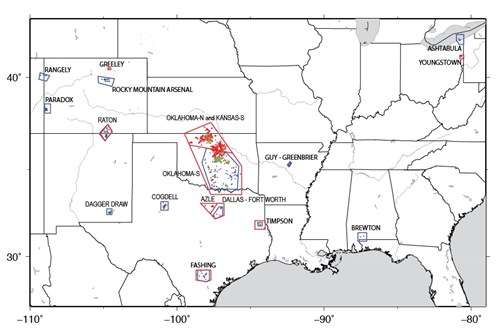
Research has identified 17 areas in the central and eastern United States with increased rates of induced seismicity. Since 2000, several of these areas have experienced high levels of seismicity, with substantial increases since 2009 that continue today.
Scientists developed the models by analyzing earthquakes in these zones and considering their rates, locations, maximum magnitude, and ground motions.
“This new report describes for the first time how injection-induced earthquakes can be incorporated into U.S. seismic hazard maps,” said Mark Petersen, Chief of the USGS National Seismic Hazard Modeling Project. “These earthquakes are occurring at a higher rate than ever before and pose a much greater risk to people living nearby. The USGS is developing methods that overcome the challenges in assessing seismic hazards in these regions in order to support decisions that help keep communities safe from ground shaking.”
These new methods and products result in part from a workshop hosted by the USGS and the Oklahoma Geological Survey. The workshop, described in the new report, brought together a broad group of experts from government, industry and academic communities to discuss the hazards from induced earthquakes.
Wastewater that is salty or polluted by chemicals needs to be disposed of in a manner that prevents contaminating freshwater sources. Large volumes of wastewater can result from a variety of processes, such as a byproduct from energy production. Wastewater injection increases the underground pore pressure, which may lubricate nearby faults thereby making earthquakes more likely to occur. Although the disposal process has the potential to trigger earthquakes, most wastewater disposal wells do not produce felt earthquakes.
Many questions have been raised about whether hydraulic fracturing—commonly referred to as “fracking”—is responsible for the recent increase of earthquakes. USGS’s studies suggest that the actual hydraulic fracturing process is only occasionally the direct cause of felt earthquakes.