Multi-tracer stage-level injection test validates production-flow and tracer quantification in a Bakken well
TALGAT SHOKANOV, QUAN GUO and JOHN OLIVER, QuantumPro, Inc.
This work describes a rigorous field test for validating production flow diagnostics data quality and reliability when deploying nanoparticle tracers for discrete, stage-level measurement. The main pilot objectives were to demonstrate consistent nanoparticle tracer concentrations across stages and evaluate whether tracer concentration mimics well production by phase. The findings highlight the reliability and unique value of applying nanoparticle tracer technology for production profiling, and they recommend a framework for tracer calibration.
Well completion programs employ production flow diagnostics to help bridge the gap between subsurface assumptions and discrete reservoir performance and behavior. Guessing what a well's drainage profile is, based purely on total surface flow, misses the opportunity to gain valuable insight, which can continuously improve production efficiency and prevent costly downhole problems. As horizontal lateral lengths and completion complexity both increase, operators require high-fidelity diagnostic tools to accurately quantify stage-specific production contributions.
STRATEGIC VALUE AND OBJECTIVES OF PRODUCTION FLOW DIAGNOSTICS
Cross-well and inter-stage communication. Discrete production flow insight can identify interference from nearby wells or between stages, guiding drilling and completion parameters. Maximizing production from the total reservoir volume requires a deep understanding of the structural limits and drainage parameters. If wells are spaced too far apart, a substantial volume of rock is never reached by the hydraulic fracture propagation. This creates an unstimulated zone, where 100% of the hydrocarbons are permanently stranded.
Conversely, drilling wells too close together causes newer "child" wells to run into pressure-depleted rock created by the older "parent" well. Because fractures naturally follow the path of least resistance, the child well's fractures pull disproportionately toward the parent's low-pressure zone. This uneven growth leaves a massive percentage of the rock on the opposite side of the child well untapped. A similar phenomenon occurs with stage spacing. Specific nanoparticle tracer technology is highly effective at capturing cross-well or inter-well communication.
Challenging the 80/20 rule. Rather than accepting that 20% of the stages will inevitably account for 80% of the production, operators learn through discrete production flow diagnostics that they can impact this often-cited norm. They use empirical data and science to test completion hypotheses and differentiate from peers, significantly improving economics and asset profitability over time.
Identifying underperforming stages is not a passive post-mortem exercise; it is an active calibration tool. Without high-fidelity validation, an operator cannot determine if low production is caused by a faulty completion design or poor rock quality. By proving the diagnostics are robust and reliable, completion engineers have access to an accurate roadmap of the production profile to alter completion geometries, fluid chemistry and drawdown management, effectively conquering subsurface heterogeneity rather than passively accepting it.
LIMITATIONS OF TRADITIONAL DIAGNOSTICS
Production analysis challenges. However, acquiring discreet, stage-level diagnostics by conventional means often comes with a steep cost and requires a level of acceptance of risk, inherent limitations, and a high degree of data uncertainty. To understand why establishing data reliability downhole is uniquely challenging, the inherent technical limitations of traditional stage-profiling methods need to be evaluated. For decades, conventional diagnostic options have left operators to build limited reservoir drainage models on qualitative interpretations, decaying signals, short-term evaluations or chemically unstable compounds.
Production Logging Tools (PLTs). Though widely used, Production Logging Tools (PLTs) introduce severe data-gap and consistency challenges, providing only a brief, qualitative "snapshot" of fluid velocity while the tool string physically passes through the lateral. They are entirely incapable of tracking long-term fluid allocation or late-time transient recovery trends over multiple weeks or months of steady-state drawdown. Furthermore, the fluid dynamics within the wellbore are heavily disrupted during the mechanical intervention itself. The tool chokes a cross-sectional area and induces frictional backpressure, compromising the baseline integrity of the recorded flow profile and complicating the desired high-confidence interpretation.
Distributed Fiber Optic Sensing (DAS/DTS), complex interpretation and fragility. While fiber optic cables offer continuous monitoring along the lateral, they struggle with interpretive consistency. Fiber lines do not directly measure fluid volume; instead, they record acoustic vibrations and thermal changes. Translating these auditory or thermal shifts into definitive barrels of oil or water per stage requires highly complex mathematical models and extensive engineering assumptions. This reliance on heavy simulation parameters shifts the data from an empirical fact to a qualitative estimation. Mechanically, fiber lines are highly fragile; if a cable suffers from signal "darkening" or physical crushing during the high-pressure frac job, the remaining data stream becomes highly fragmented or halted entirely, further degrading the reliability of the model.
Conventional chemical and molecular tracers, degradation and limits. Liquid-phase chemical tracers, such as organic fluorinated benzoic acids, eliminate mechanical wellbore risks but introduce chemical instability. When exposed to high-temperature, high-pressure (HTHP) reservoir environments, the molecular bonds of conventional chemical tracers frequently undergo thermal degradation or rock surface adsorption. This structural breakdown causes an artificial drop in recovered tracer concentrations over time. Because the chemical compounds literally disappear under intense reservoir heat, the recovery curve is corrupted, preventing the establishment of a reliable, multi-week baseline. Crucially, conventional chemistry hits a rigid scalability ceiling with a limited number of oil and water-soluble tracers. When scaling to modern completions, featuring dozens of stages across single or multiple wells on the single pad, the tracers often fall short and run out of unique options.
Nanoparticle tracer stability, delivery, longevity and scale. To overcome the physical limitations of traditional chemical tracers, nanoparticle tracer technology relies on a completely different paradigm: sub-atomic, discrete coding. Rather than altering a molecule's shape or weight to generate a new signature, nanoparticle tracers utilize an inert, highly stable and uniquely engineered nanoparticle. The design eliminates the root causes of subsurface chemical interference. This also allows operators to scale seamlessly to up to 220 distinct, non-interfering tracer signatures, making both full lateral coverage and cross-well interference evaluation operationally viable. Further, the discrete particles are non-hazardous, non-radioactive, detectable for up to 12 months and are delivered to the formation via a non-intrusive dosing pump down, unlike PLTs and DAS/DTS that require special handling and intervention.
Because the nanoparticles are engineered as completely inert, inorganic structures, they are physically incapable of dissolving or chemically partitioning between fluid phases. Rather than relying on phase-targeted chemical affinity or surface coatings, the nanoparticles act as purely passive physical markers of each phase flow.
The structure of the nanoparticles exhibits extreme thermal stability, and they comfortably withstand downhole temperatures up to 2,000°F without breaking down or losing signature integrity. This ensures a perfectly stable baseline for multi-month recovery tracking and production mapping.
FIELD EXECUTION, DATA ANALYSIS AND OPERATIONAL RECOMMENDATION
Pilot setting and technical objectives. To validate the subsurface transport consistency and analytical reliability of inert nanoparticle tracers, a specialized field validation study was executed in late 2024 to early 2025. QuantumPro, Inc., working alongside an asset operator in the Williston basin, conducted a field pilot on a horizontal well completed along the structural trend of the Nesson Anticline in the Middle Bakken.
The Bakken test well was drilled toe-up to the north with a total measured depth (MD) of ~20,000 ft and a true vertical depth (TVD) of ~10,000 ft. The stimulation program comprised a 21-stage plug-and-perforation completion design.
The fracturing treatment utilized a high-rate slickwater design pumping at an expected maximum rate of 100 barrels per minute (bpm). Proppant placement featured a balanced blend of 100-mesh and 40/70-mesh white sand, placing roughly 500,000 pounds of sand per completion interval to maximize near-wellbore fracture conductivity.
Multi-nanoparticle-tracer co-injection test protocol. The primary goal of the technical pilot was to establish a robust validation framework for stage-specific fluid allocation. By measuring transient flowback behavior across multiple weeks, the project aimed to answer the core question facing tracer metrics: do identical physical particles transport uniformly through a highly complex, horizontal wellbore?
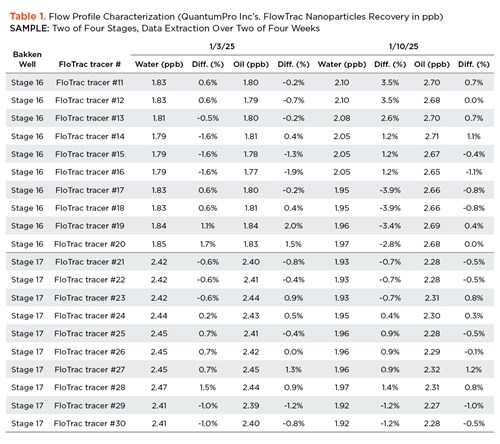
To build a mathematically uncompromised quality control baseline, a specialized multi-tracer co-injection protocol was integrated into primary fracturing operations. Instead of the traditional deployment configuration of injecting a single unique nanoparticle tracer per stage, the engineering teams deployed ten distinctly engineered nanoparticle tracers simultaneously into a single stage. This simultaneous co-injection array was executed sequentially, across five contiguous completion zones, specifically tracking Stages 15, 16, 17, 18 and 19. A total of 50 unique nanoparticle tracer tags were utilized, Table 1.
The surface equipment configuration required connecting an automated dosing pump system, managed by QuantumPro, Inc., directly to the service provider’s frac blender unit. This manifold arrangement ensured that for each targeted stage, all ten distinct nanoparticle signatures were injected into the blender tub in real time at an identical pump rate, matching base concentration and identical start and stop timestamps.
Fluid samples were collected over five distinct but variable intervals before the deployment of artificial lift. The multi-phase fluids were routed through a standard three-phase surface separator to isolate the water and crude oil streams, directing the phase-neutral nanoparticles into separate recovery tanks for phase-specific tracking.
Dimensionless normalization index methodology. Directly comparing raw surface fluid volumes, measured in barrels per day (bpd), against nanoparticle tracer recovery curves, measured in parts per billion (ppb), introduces data-skew, due to different baseline units. To establish a clean comparison framework, the project utilized a dimensionless normalization index method. Both parameters were mathematically indexed to a baseline of 1.0 and anchored precisely to the date of the first tracer sampling event, on Jan. 3, 2025.
The Production Index was calculated for each phase independently by dividing the daily fluid production rate by the baseline production rate recorded on day 1. The Tracer Index was calculated identically for each unique nanoparticle tracer by dividing the daily parts-per-billion (ppb) concentration by the baseline concentration captured on day 1.
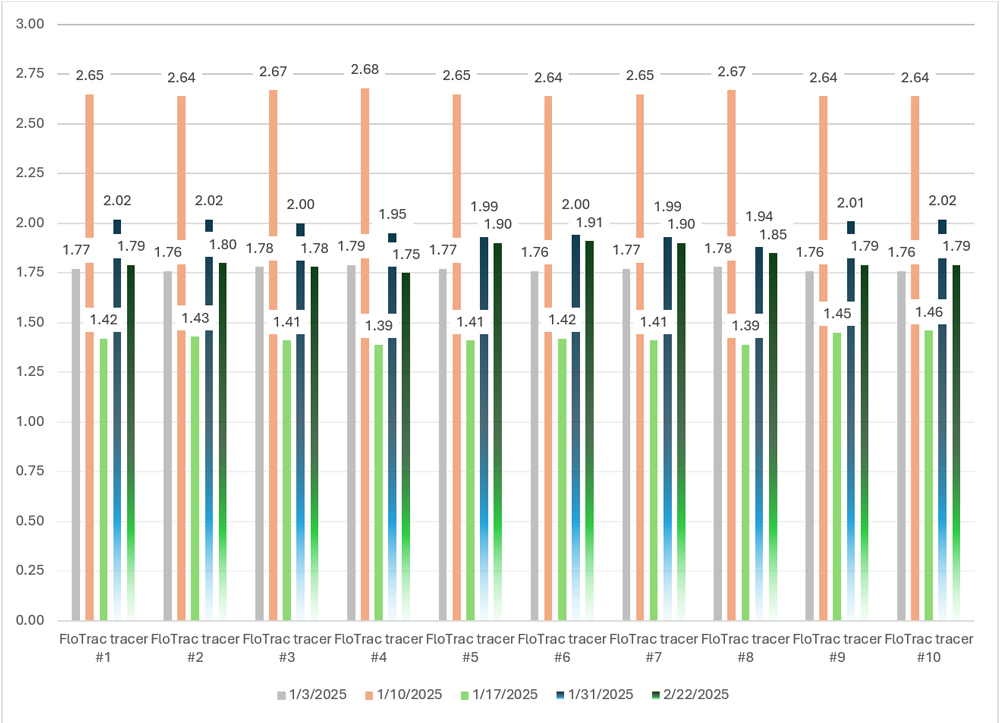
By converting both parameters into dimensionless values, the interpretation team established a direct, 1:1 linear comparison framework. If a nanoparticle tracer functions perfectly as a passive fluid flow tracker, the tracer index, over time, matches the trajectory of the Production Index, Fig. 1, 2.
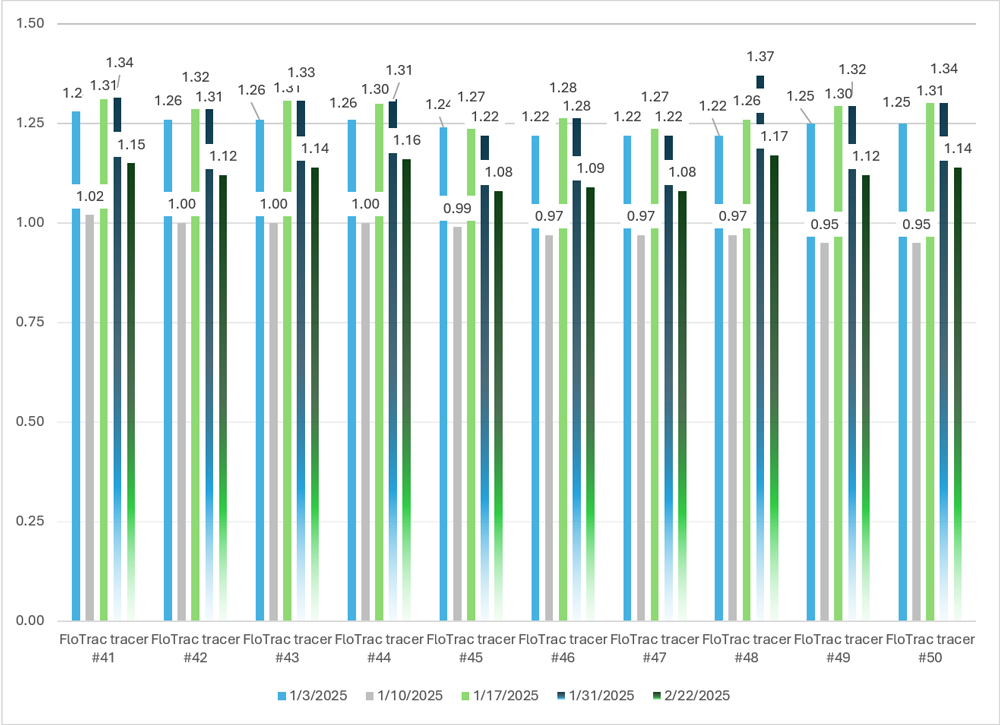
Nanoparticle tracer neutrality and analytical precision. The analysis of the recovered fluid samples delivered high-fidelity results, confirming nanoparticle tracer neutrality and subsurface transport behavior. The cornerstone proof of data integrity was established via the internal standard deviation of the co-injected nanoparticle tracers. Because the ten nanoparticle tracers inside a single stage are designed to behave identically, while maintaining a unique signature, they should return to the surface in near-identical concentrations.
The calibration test demonstrated exceptional data consistency. For Stage 15, the recovered concentrations across all ten distinct tracer streams clustered tightly, yielding an internal standard deviation of less than 0.6%. Across the multi-week study, the maximum standard deviation observed between co-injected markers across all stages peaked at just 5.3%. This tight statistical grouping proves that the engineered modifications used to prepare the nanoparticle tracers do not alter the physical transport properties or baseline mobility of the nanoparticle.
SUMMARY POINTS
The operator provided excellent field execution and sampling feedback, and the standard deviation response for water and oil was excellent.
Recommendations proposed for future development programs:
- Investigate standard deviation increases over time in a renewed calibration test.
- Take additional samples over time, to verify and determine constraints and limitations.
- For production profiling, ensure inclusion of samples at high/med/low production rates, with greater production variability to test limits.
- Expand coverage and measurement scope and trace all stages of future laterals with multiple tracers per stage (injected at the same concentration for further calibration analysis or spaced across the stage for far-field flow diagnostics within each frac).
CONCLUSION
The results demonstrate a high degree of correlation, validating the technology's ability to mimic wellbore flow while retaining consistent results across the array of inert nanoparticle tracers deployed. The test framework represents a highly rigorous protocol for validating results and adding confidence to insight, interpretation and completion testing and optimization planning.
TALGAT SHOKANOV is CEO of QuantumPro, Inc., which he founded in 2017, following a 15-year career at SLB, where he held a variety of international and technology development assignments. He previously spearheaded SLB’s cuttings re-injection via hydraulic fracturing business line, including subsurface engineering, disposal domain mapping and pressure diagnostics analysis. Mr. Shokanov holds numerous patents and has authored over 50 technical papers in complex fracturing and injection. He holds bachelor’s and master’s degrees in petroleum engineering from Satbayev University in Kazakhstan.
QUAN GUO is a geomechanics advisor at QuantumPro, Inc. He was with M-I SWACO and later, SLB, from 2003 to 2022. Before M-I SWACO, he was with Advantek from 2000 to 2003 and TerraTek from 1992 to 2000. His experience includes perforating and hydraulic fracturing lab testing and modeling, drilling fluids and wellbore strengthening, cuttings and produced water re-injection. Mr. Guo holds 13 patents and has authored over 80 technical papers. He holds a bachelor’s degree in mathematics and mechanics from Lanzhou University, a master’s degree in engineering mechanics from Huazhong University of Science and Technology in China and a doctorate in mechanical engineering from Northwestern University, Evanston, Ill.
JOHN OLIVER is a business strategy advisor to QuantumPro, Inc. He has over 40 years of experience in the oil and gas industry, including several senior executive positions with M-I SWACO, an SLB company. He managed all the segments in the South American business unit as Senior VP and served as Global Marketing Manager. Mr. Oliver went on to lead Prince Energy, a division of Prince International, from which he retired in July 2018. He currently serves on several boards and is an advisor to several companies, as well as energy private equity investment firms. He holds a bachelor’s degree with honors in biochemistry from University of St Andrews in Scotland.
Related Articles- What's new in production: Lighten up (June)
- What's new in production: When everything is going wrong at the same time (April)
- Regional Report: Brazil reaches for new heights in 2026 (March)
- What's new in production: Things go better with Coke (February)
- Before OPEC, there was Texas: A better path for Venezuela’s oil revival (February)
- International E&P shows the way forward (February)