Drilling Advances: Auto-Driller vs Robo-Driller vs THE BORG
FORD BRETT, CONTRIBUTING EDITOR
To make these stand-alone articles—in case you miss one and so that you can share individual articles with others—I have a ‘red thread’ story line through each. Diligent—and impatient— readers can skip the Background below and skip ahead to Automatically Making Hole.
Background: North America’s gas challenge and the promise of automation. LNG and data center expansion mean North America needs ~30 Bcfd of new natural gas over the next five years—the largest and fastest demand increase in industry history. Meeting the demand will take 100 to 200 additional rigs focused on gas.
Our challenge is not geology or drilling capability. We know where the gas is, and we have the know-how to get it. Instead, three bottlenecks will limit supply growth: 1) Limited midstream infrastructure; 2) Permitting and regulatory constraints; and 3) the long-standing “Performance Twist-off” problem, where drilling performance declines as rig activity increases.
The first two bottlenecks seem like they have nothing to do with drilling, but drillers can indeed help our midstream brothers and sisters address these with longer laterals. Extending lateral lengths from 5,000 ft to 20,000 ft reduces required surface locations and gathering pipelines by a factor of 16. In effect, drillers can replace costly and difficult-to-permit surface infrastructure with “gathering lines” placed directly in the reservoir. Details are explained in my March 2026 column, Gas – What’s a mother to do?
The third bottleneck, however, is a straight-up drilling problem. History shows that whenever rig count rises, drilling efficiency falls. This is mainly a people—not lack of equipment—problem. High-performing crews take time to build, train and develop. Expanded activity dilutes experience and adds billions of dollars in industry costs and increases the rate of incidents. How higher activity levels can create both financial and human costs is described in my September 2024 column, What is the performance twist-off cost?
To meet the unprecedented gas demand without a drastic drop in efficiency (Performance Twist-off), automation offers a solution to the third bottleneck by both removing people from hazardous areas and by using robotics to deliver consistent performance. Automated tripping and connection systems remove personnel from the rig floor during key operations and provide the safest possible outcome: no personnel in harm’s way.
The prior article in this series, John Henry vs the steam drill: Will the robots win?, described H&P’s efforts to automate tripping and connections. H&P views automated tripping and connections as a tool to enhance performance, rather than replace people. Standard crew sizes are maintained while personnel focus on equipment reliability, maintenance, and operational excellence.
Rather than relying solely on crew experience, automated systems consistently execute repetitive tasks to predetermined performance targets and let rigs achieve reliable results, regardless of activity levels. Automation can unexpectedly help with rig maintenance. As drilling operations become faster, crews often struggle to find time for routine equipment upkeep, automation creates space in fast paced operations for maintenance and improves long-term reliability.
Automatically making hole. To meet the unprecedented gas demand without a drastic drop in efficiency (Performance Twist-off), the industry must replace variable human execution with consistent, predictive automation. This has been a long-term effort by many in the industry, but what used to seem like science fiction is becoming more and more reality. All this automation started where it would add the most value—deepwater offshore and for managed pressure drilling—it’s proven there and is now continually improving and has moved onto land.
These advancements in drilling automation have been prompted by operators (such as Equinor, ADNOC, Petrobras, ExxonMobil, Chevron, COP, Oxy, ENI and others) concerned with this problem. They have been facilitated by equipment manufacturers (such as NOV & Huisman) and service companies developing intelligent control systems (SLB, Halliburton, Baker Hughes and others) and implemented by drilling contractors (such as H&P, Nabors, Patterson-UTI, and others). All of this was not easy.
The purpose of this Drilling Advances edition is to describe why automatically drilling ahead is not that easy, the tricks to making it happen, just what it gets you when done properly, and what the future may hold when the industry connects automated rigs into a “Drilling BORG.”
I’ll use, as a case study, H&P’s “optimal controller.” Many thanks to H&P’s Sonny Auld, Principal Product Manager, and Zack Whitlow, Control Algorithm Engineer, for their time, insights and candor in explaining H&P’s automation journey. It’s their work, and others at H&P, that’s described here.
The first generation of the “optimal controller” described here was rolled out commercially in 2020 and has been continually improved since then. It is now available on all of H&P’s FlexRig fleet. I like to distinguish H&P’s Autodriller Pro optimal controller from a conventional Auto-Driller by calling it a Robo-Driller.
Controlling weight on bit is hard. On the face of it, controlling the weight on bit seems simple: lower the block to add weight, pick up to take weight off. While that is true, non-trivial problems appear when you want to control exactly how much weight on the bit, as you drill ahead in a real well.
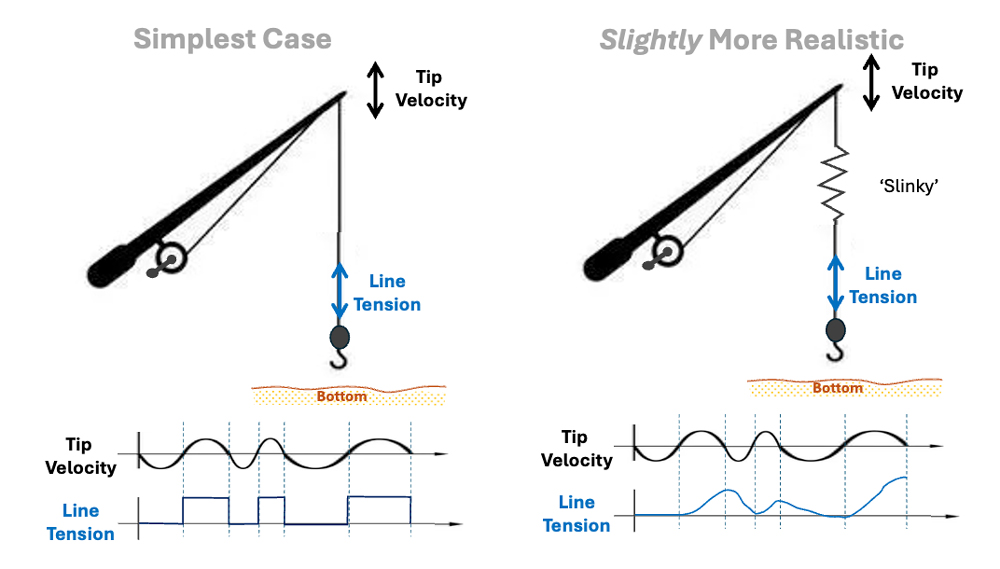
Figure 1 shows just one of the reasons why the situation is complicated. You can easily imagine using a fishing pole to set the bait on the bottom of a lake. If you want the bait to be just above the bottom, you set down, feel the weight go away and pick up—not too difficult. Controlling weight on bit is similar in principle, but much more complicated in reality. The simplest confounding factor in the real world is the elasticity of the drillstring. In the fishing example, image a child’s slinky toy instead of a fishing line. Knowing what the line tension is at the hook, as a function of time, is much more difficult with a slinky.
Even worse, it’s not only the “springiness” of the drillstring that confounds knowing the weight on bit, the inertia of the drillstring also comes into play. Inertia causes control lags and overshoot. The effect of inertia is experienced when trying to dock a motorboat, even after you cut the engine, you are still going forward. Getting to a dock without ramming the boat is tricky, and that is the reason why rental boats have so many bumpers. (Jumping ahead a bit, but Fig. 3 shows that the inertia can cause delays on the order of 30 sec in real wells).
The drillstrings have both springiness and inertia AND loads of other confounding factors, all making control of the weight-on-bit much different than putting bait on the bottom of a lake. Table 1 lists the most obvious and important factors that make weight-on-bit control problematic. Each of these most obvious factors are important enough to severely damage a PDC bit, if not handled properly.
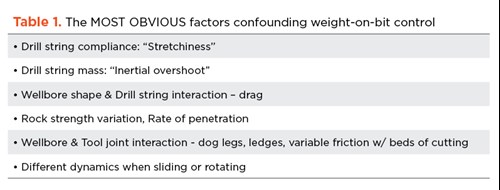
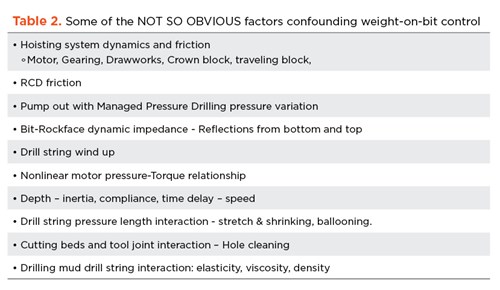
Table 2 shows additional items that affect weight-on-bit control. Depending on the situation, any of these factors can significantly change weight-on-bit and affect drilling economics and bit life. Controlling the weight on the bit for the obvious factors is difficult enough, but real life is even more complicated.
This isn’t a technical paper on drilling dynamics—not the time nor the place to cover how and when they are relevant, and what all that means for controlling weight-on-bit. The point is that controlling the weight-on-bit is complicated, it changes from well to well, it changes as conditions change within a well, and it is a complicated function of time, so that what is going on right now depends on what you did 30 sec ago.
To make matters worse, controlling weight-on-bit is hard enough in theory, when going to bottom with a mud motor. The driller needs to control three things: rotary speed, block velocity and pump rate, but he only has two hands.
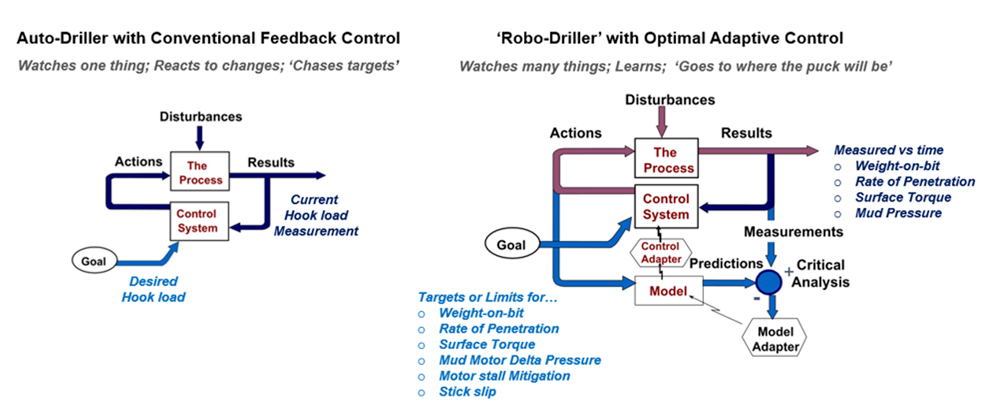
Auto Drillers vs Robo Drillers—Why a model is important. Auto-drillers go way back. The approach that H&P (and others) are using to control weight-on bit while drilling ahead is completely different. Conventional auto-drillers use feedback control to take one measure (hookload) and feed out the drawworks at a rate proportional to the difference between the measured hookload and the desired hookload. Figure 2 illustrates how that works.
With this approach all of the confounding factors and the inherent physics of the system mean that there is always some error between the desired and actual weight on bit. The system is slow to respond to the factors in Tables 1 and 2, Auto-Drillers are doomed to over or under shoot the desired weight on bit. The result is that conventional feedback control is always ‘chasing’ the desired result. Auto-Drillers are good in that it can perform acceptably without anyone needing to watch and control, but they are inherently slow to respond and don’t change in response to changing wellbore conditions and therefore are less than optimum.
The right of Figure 2 shows a schematic of an adaptive control process. This approach is how guided missiles, and some process control in refineries and chemical plants work. To do better than conventional control, a ‘model’ is added and continually compares it’s predictions with what’s actually happening in reality and improves the model to improve how it can mimic reality. It uses this better understanding to ‘adapt’ how it controls the system. Adaptive models like this ‘learn’ to get better results by being able to anticipate what will happen and adjust beforehand.
Such adaptive control algorithms can also handle not just one control parameter, but many. The figure shows some of the parameters that H&P models and controls. H&P’s Autodriller Pro accurately calls this an “optimal control algorithm” I call it a Robo-Driller, because it sounds cooler.
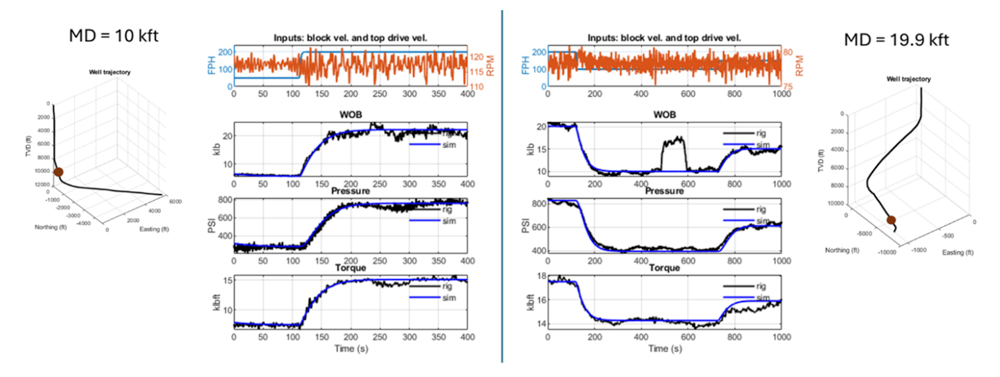
Figure 3 shows an example of how, and why, a model is important to understand how to effectively control weight-on-bit by moving the block that can be 5 mi (8 km) away, connected by time delays, and a “slinky” along a windy and bumpy road. Simply moving the block does not change the weight on the bit in intuitive ways.
The data shown here are of the model alone, without the control system operating. The H&P controller tunes a version of this model to account for hole geometry and the drillstring parameters, and inferred rock drill ability.
Interestingly, the orange curve in the upper trace shows the top drive rpm. The reason that the RPM varies so much is that the top drive controller (H&P’s FlexTorque) is preventing stick slip and working to keep constant conditions at the bit. The rotary surface speed needs to constantly adjust because of the torsional springiness and inertia of the drillstring. When the weight-on-bit controller is operating, the block velocity has similar variability.
Another interesting point is the large variation in the actual and modeled weight on the bit in the second trace, on the right-hand side of the figure. This difference happens, because this generation of the model did not take into account when a tool joint went through the RCD. Without accounting for this drag, the weight on the bit would actually (in this case) decline by some almost 10k lbs. The H&P controller takes this into account, so that when a tool joint goes thru the RDC, the weight on the bit won’t change.
Without a model that’s updated by real measures, you are doomed to continually “chasing” the target. You will be late and have greater gap between what you desire and what is actually happening. Models help the system predict what will happen and take the right action now. An accurate model keeps you from “chasing” the system and act in anticipation of what is going to happen.
People say Wayne Gretsky was such a good ice hockey player, not because he could skate faster, but because he skated to where the puck was going to be. Wayne’s model—how he understood what would happen in a given situation and how he changed it for different situations—was his winning difference. Robo-Drillers’ model lets them think ahead, too.
So what? What does all this get you? An Auto-Driller gets you hit-or-miss control of one drilling parameter. Robo-Drillers do better. H&P’s FlexFusion® Platform automates all of the operations shown in Table 3. This solves the “three things, two hands” problem, addresses the fact that knowing what’s controlling what’s going on at the bit is hard, because of everything in Tables 1 and 2, and listens to the well all the time.
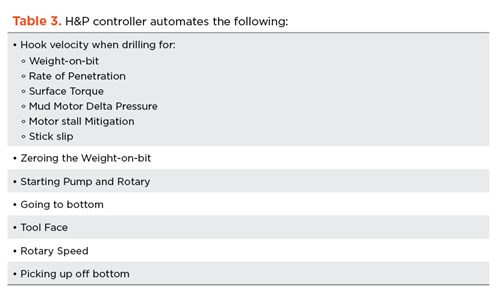
“Optimally” controlling all of these factors results in reduced overshoot and undershoot, smoother WOB control, more efficient motor control, less stalls. It’s hard to quantify the effect in a single foot of drilling, but over the course of many wells, H&P has demonstrated improvements in ROP and bit life that have led to 15% to 25% reduction in drilling ahead time. The size of the prize seems to depend on how close the current operation is to perfect. H&P’s FlexFusion® Platform delivers scalable drilling performance improvements.
A recent, and typical, 20k-ft lateral shale well (26.5k ft, MD), illustrate the potential benefits of such a performance. The well took 24.5 days to drill, with 32% of the time spent on drilling. A +/-20% improvement in drilling time works out to about 1.5 days per well. That 1.5 days per well adds up to almost a full well over the course of a year.
Interestingly, one important cause of this improved performance isn’t from preventing weight from being dumped on and damaging the bit, but also in keeping enough weight on the bit to prevent bit whirl. Too much weight can mess up a bit, but TOO LITTLE weight can cause whirl and may catastrophically damage a bit too. (Ref: Brett, Warren, Behr; 1990, SPE 19571, “Bit whirl a new theory of PDC bit failure”).
Bit whirl is also a reason why how a bit starts and stops drilling is important. To put a bit with a motor on bottom properly, you need accurate and timely control of the pump rate, rotary speed, and hook velocity. That’s three things to control; a driller only has two hands. And exactly how changes at the surface affect what’s going on at the bit is hard to know without a model.
All of this seems good, but probably the best testimony for the usefulness of H&P’s FlexFusion® Platform Robo-Driller is that their largest clients—some of the most active drillers on the planet—are the system’s biggest adopters.
Robo-Driller to THE BORG. As you likely know from Star Trek movies, The BORG are a civilization with a “hive mind,” where what was known by one person is known by them all. The Robo-Driller described above is what one individual “robot” does to do his best to drill efficiently on a particular well and a particular moment in time. This section muses about a future, where one uses the cloud and data from EVERY WELL to improve, to make a Drilling-BORG to improve.
One beautiful thing about automation is that it will listen to the well all the time and can remember things that drillers might forget or that some other driller knew but didn’t relay. When detailed drilling data from every well are taken to the cloud, and combined and analyzed in real time as a whole, what happens is that the system doesn’t just listen to THIS well, it listens to EVERY well.
Listening to every well helps turn noise into signal by aggregating subtle differences in how the control algorithm performs across many wells. It’s a little bit like how submarines can hear the whales and ships miles away by listening for a long period of time. It’s also how amateur astronomers can take many individually quite dull images and combine them for spectacular photos of nebulas. Noise is something that is caused by something, but we just don’t happen to understand yet. H&P and others (e.g. Intellicess) are working to take the ‘Robo-Drillers’ and combine them into a Drilling BORG.
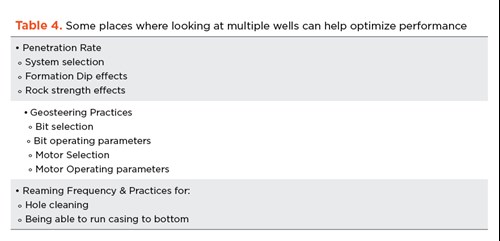
Table 4 lists some of the areas where a drilling BORG could improve drilling performance. It could improve by aggregating weak signals to better understand and better control what’s going on. It’s hard to estimate exactly the size of the potential prize, but building wells so that you can reliably run casing to bottom in a 20k lateral would be a big help. Perhaps total potential gain is on the order of 20% to 25% in drilling performance and maybe eliminating an even greater percentage of trouble time.
The hive mind of the Borg in Star Trek is nefarious. Combining what has happened and what is happening on all rigs to improve offers opportunity. H&P has plans to take the optimal control algorithm to the cloud, to understand how performance on every H&P rig can be used to improve all future wells.
Robo-Drilling (and Automated Tripping/Connections) will help address the Performance Twist-off that we can expect, as activity grows to meet gas demand by ensuring drilling performance and safety don’t regress. But that’s just part of the reason the twist-off happens. It’s the performance of the entire team—Engineering, Production and Geoscience. A Drilling-Borg offers the opportunity of limiting regress in those parts of the team by helping to ensure best practices are transferred in those areas, as well.
This is all work in progress; will future editions of Drilling Advances describe how a Drilling BORG makes life better? One caveat related to The BORG is that I.T. security won’t just be nice to have.
Until next time, I hope to start a conversation with any of you on how we can all help Drilling Advance. If you have any questions, ideas, comments or corrections, please email me at ford.brett@petroskills.com, and I promise I’ll respond.
Related Articles- Why a common safety standard still matters in a global energy workforce (June)
- Baker Hughes executive assesses progress in artificial lift systems (June)
- Drilling technology: Optimizing high-pressure pump performance with fluid end advances (May)
- A Baker Hughes executive assesses the electrification effort (May)
- Simplified intelligent completion architectures improve zonal control economics (May)
- John Henry vs the steam drill: Will the robots win? (May)